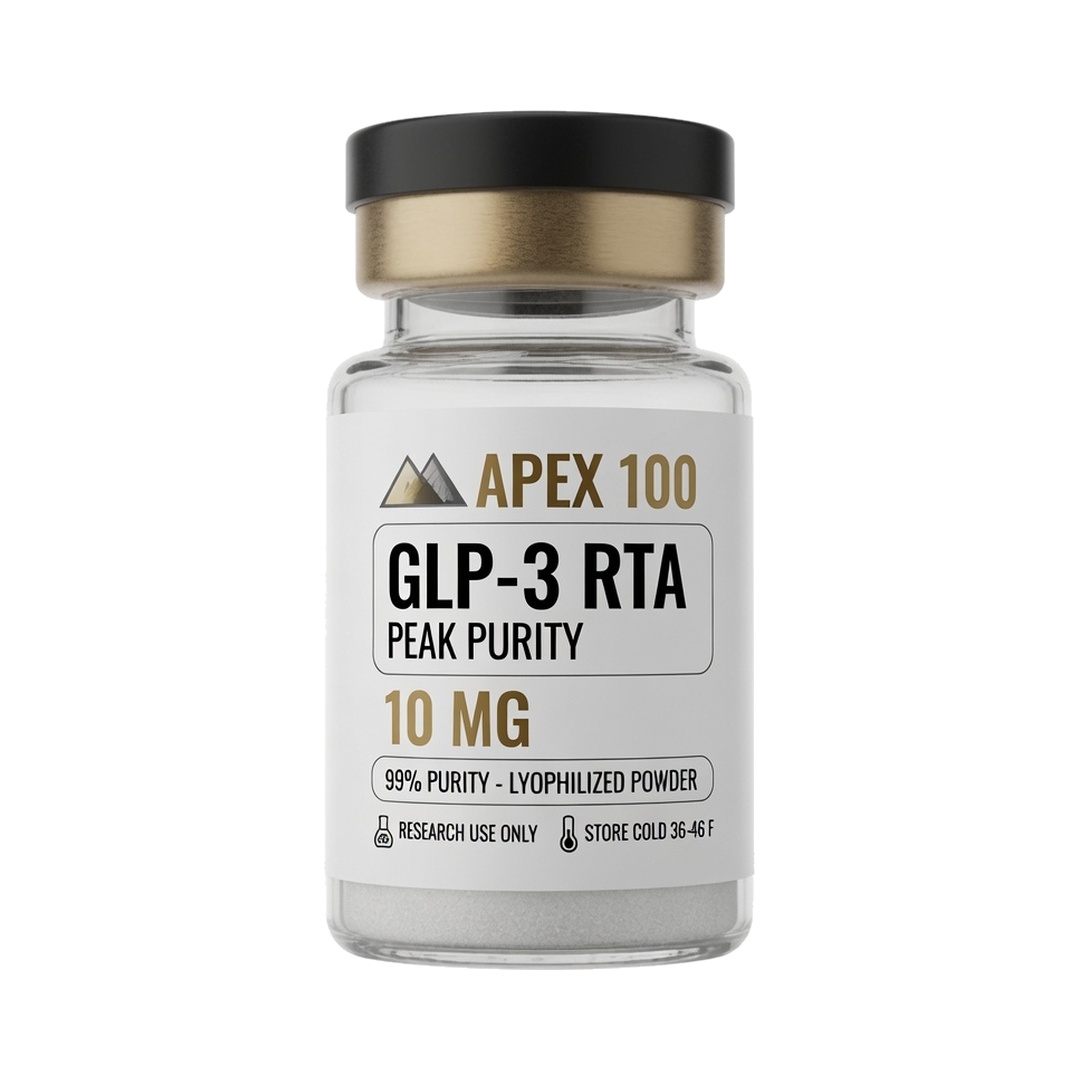
Retatrutide
A single-molecule triple agonist at the GLP-1, GIP and glucagon receptors — the newest frontier in metabolic research.
Get the full guide →Overview
Retatrutide is a synthetic 39–amino-acid peptide investigated as a first-in-class triple incretin agonist. Where earlier metabolic peptides engage one or two receptors, retatrutide is engineered to activate three simultaneously, making it one of the most studied experimental metabolic compounds of the decade.
Mechanism & receptor biology
In receptor-pharmacology studies it acts as an agonist at the glucagon-like peptide-1 (GLP-1), glucose-dependent insulinotropic polypeptide (GIP) and glucagon (GCGR) receptors. This combined engagement is the focus of research into how simultaneous incretin and glucagon signaling influences energy-balance pathways in model systems.
Research context
Preclinical and early-phase literature examines retatrutide's receptor binding, signaling kinetics and metabolic-pathway modulation. In a laboratory setting it is used as a reference tool for studying multi-receptor incretin biology.
Reference specifications
| Sequence | 39-residue acylated peptide |
|---|---|
| Molecular formula | C₂₂₁H₃₄₂N₄₆O₆₈ |
| Molecular weight | 4731.33 g/mol |
| CAS number | 2381089-83-2 |
Retatrutide is offered strictly for laboratory and research use only. It is not a drug, supplement, or article of food, and is not intended to diagnose, treat, cure, or prevent any disease, nor for human or animal consumption. The information above is an educational summary of published receptor biology and does not constitute medical advice.
Related compounds in Metabolic — GLP & Amylin
Get the full Peptide Research Guide
The complete reference — all 20 compound profiles, five research classes, receptor biology and laboratory-grade standards — plus a free reconstitution calculator, delivered as a PDF.
Get the free guide →