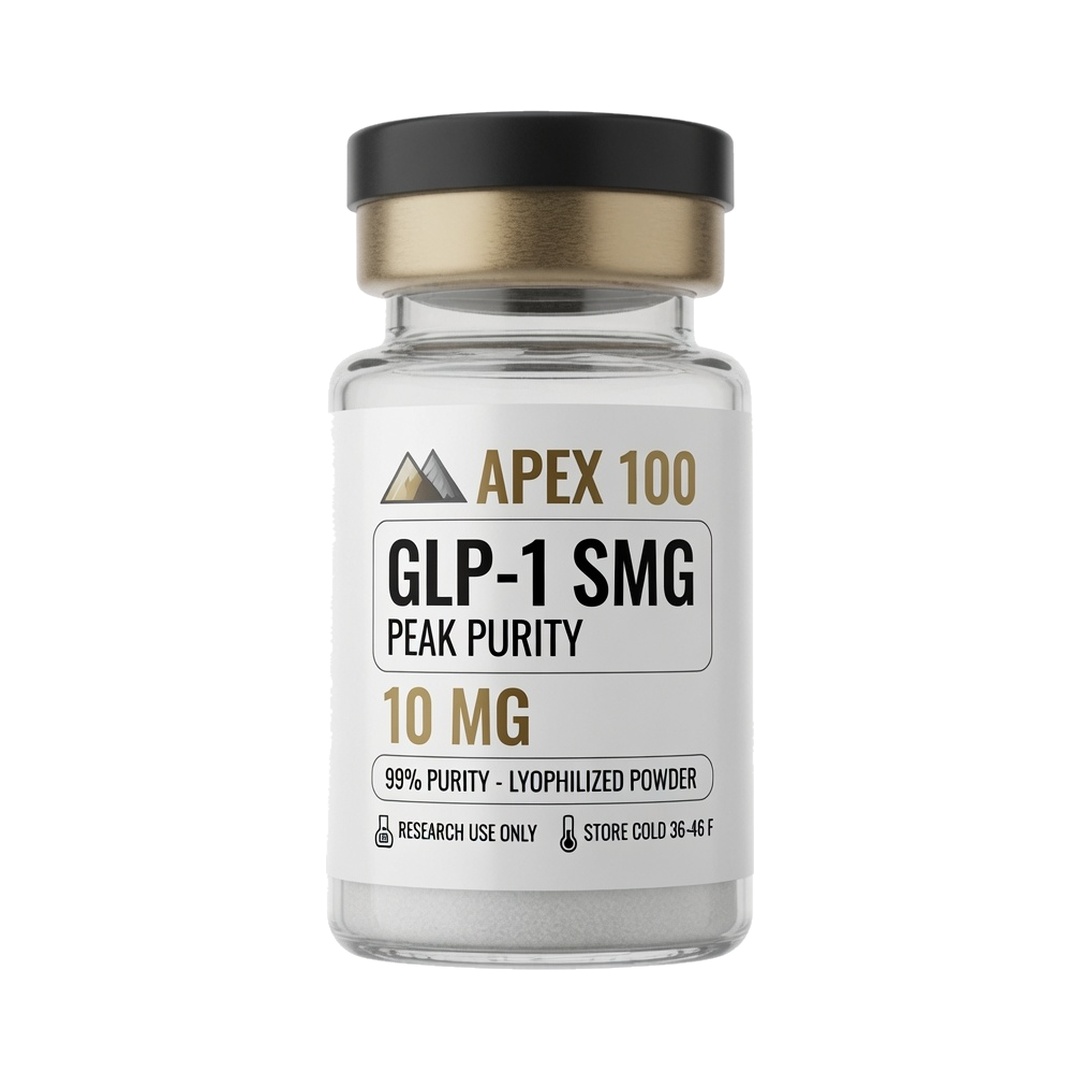
Semaglutide
The reference GLP-1 agonist against which newer metabolic peptides are measured.
Get the full guide →Overview
Semaglutide is an acylated GLP-1 analog built on a modified peptide backbone with high resistance to enzymatic degradation. As the most-studied single-receptor incretin agonist, it serves as the standard comparator in metabolic peptide research.
Mechanism & receptor biology
It binds and activates the GLP-1 receptor, a class-B G-protein-coupled receptor. Studies examine its receptor affinity, cAMP signaling and the structural modifications (an Aib substitution and a C18 fatty-diacid chain) that give it a long half-life in model systems.
Research context
Semaglutide is used in laboratory research as a well-characterized GLP-1R reference agonist for receptor assays and comparative signaling work.
Reference specifications
| Sequence | 31-residue acylated analog |
|---|---|
| Molecular formula | C₁₈₇H₂₉₁N₄₅O₅₉ |
| Molecular weight | 4113.58 g/mol |
| CAS number | 910463-68-2 |
Semaglutide is offered strictly for laboratory and research use only. It is not a drug, supplement, or article of food, and is not intended to diagnose, treat, cure, or prevent any disease, nor for human or animal consumption. The information above is an educational summary of published receptor biology and does not constitute medical advice.
Related compounds in Metabolic — GLP & Amylin
Get the full Peptide Research Guide
The complete reference — all 20 compound profiles, five research classes, receptor biology and laboratory-grade standards — plus a free reconstitution calculator, delivered as a PDF.
Get the free guide →